
Mindset Behaviours Analysis
Empower your students with the entrepreneurial mindset
Mindset Behaviours Analysis is an award-winning teaching tool, developed by the Entrepreneurial Mindset Network. The tool is FREE to use by educators who want to introduce their students to the concept of the entrepreneurial mindset and its practical application in studying, project work, and career planning for employment or entrepreneurship.Entrepreneurial Mindset Network is an international community of practice for the creation of value in society through the use of the entrepreneurial mindset by higher education leaders, intrapreneurs, public policy innovators, business owners, ecosystem builders and learning innovators.Paul Coyle is the Founder and Executive Director of the Entrepreneurial Mindset Network and the lead developer of the Mindset Behaviours Analysis tool. He is an expert in the entrepreneurial mindset, innovation, entrepreneurship, leadership and organisational change.
Validation of the MBA tool
The validity of the tool is grounded in pedagogical research on learning by doing, reflective practice, self-assessment and digital tools.The tool was awarded a Teaching Excellence Award at the 20th European Conference in Innovation and Entrepreneurship.The tool has been used by students from students in 67 countries who have awarded a satisfaction score of 87%.Educators have confirmed that the tool provides active and personalised learning that improves entrepreneurial behaviours.All data collected by the MBA tools is anonymised, in accordance with the European Union’s General Data Protection Regulation.
Preparing to use the MBA tool
Educators can sign up to use the MBA tool. Use of the tool is FREE. After sign-up you will receive:
✓ A link to a test version of the tool so you can familiarise yourself with the tool before you use it with students✓ A short guide to using the tool with your students plus the case history of the development of the MBA tool.✓ A PowerPoint slide that you can display to students with a QR code so they they can access the MBA tool
Join the educators from 21 countries who have signed up to use the MBA tool: Albania, Australia, Austria, China, England, France, Germany, India, Ireland, Japan, Malaysia, Mozambique, Nigeria, the Netherlands, Northern Ireland, Portugal, Romania, South Africa, South Korea, Sweden and the USA. The tool is written in English, and it has also been translated into Albanian and Portuguese versions.
Using the MBA tool in the classroom
The tool has 3 learning outcomes, based on Bloom's taxonomy, that are relevant to the diversity of student learning needs & career aspirations.
Outcome 1: To understand the behaviours that define the entrepreneurial mindset.Outcome 2: To self-analyse existing entrepreneurial behaviours.Outcome 3: To take action to change behaviours and act entrepreneurially more often.
The objective of the MBA tool is not to measure the entrepreneurial mindset but rather to stimulate a formative self-reflection process.An educator can follow six simple steps to using the Mindset Behaviours Analysis (MBA) tool
in the classroom with students from any academic discipline: -
Step 1: Set the context and introduce students to the MBA tool
Step 2: Share a QR code so students can access the tool on their phones
Step 3: Give students 10 minutes to answer all the questions in the tool
Step 4: Check each student has received an email with their results
Step 5: Facilitate group discussions and a comparison of results
Step 6: Explain the connection to your overall learning aims
Would you prefer to have a webinar delivered on your behalf to your students?
How students benefit from using the tool
The MBA tool uses a definition of the mindset based on seven entrepreneurial behaviours. One entrepreneurial behaviour is allocated to each of the seven letters in the word MINDSET. This MINDSET mnemonic makes it easy for students to understand and to remember the definition.

For each of the seven behaviours the tool gives examples of entrepreneurs and students using the behaviour. Students are asked to state how often they currently use each of the entrepreneurial behaviours. Students are asked to suggest an action that they could take to behave more entrepreneurially in the future.On average it takes a student around about 10 minutes to answer all the questions in the MBA tool. They immediately receive an email with all the questions and answers, including their 7 point action plan.
How an educator can enhance student learning
An innovation of the MBA tool is its ability to provide a visual analysis of the range of entrepreneurial behaviours in a student group.A slide deck shows the frequency distribution of the current use of each of the seven entrepreneurial behaviours by a group of students. Educators can see the full range of abilities amongst students and can tailor their teaching according to individual student needs. Each slide includes an AI summary of the actions suggested by students by which they aim to behave more entrepreneurially in the future.An example slide is shown below for the behaviour I Innovate.
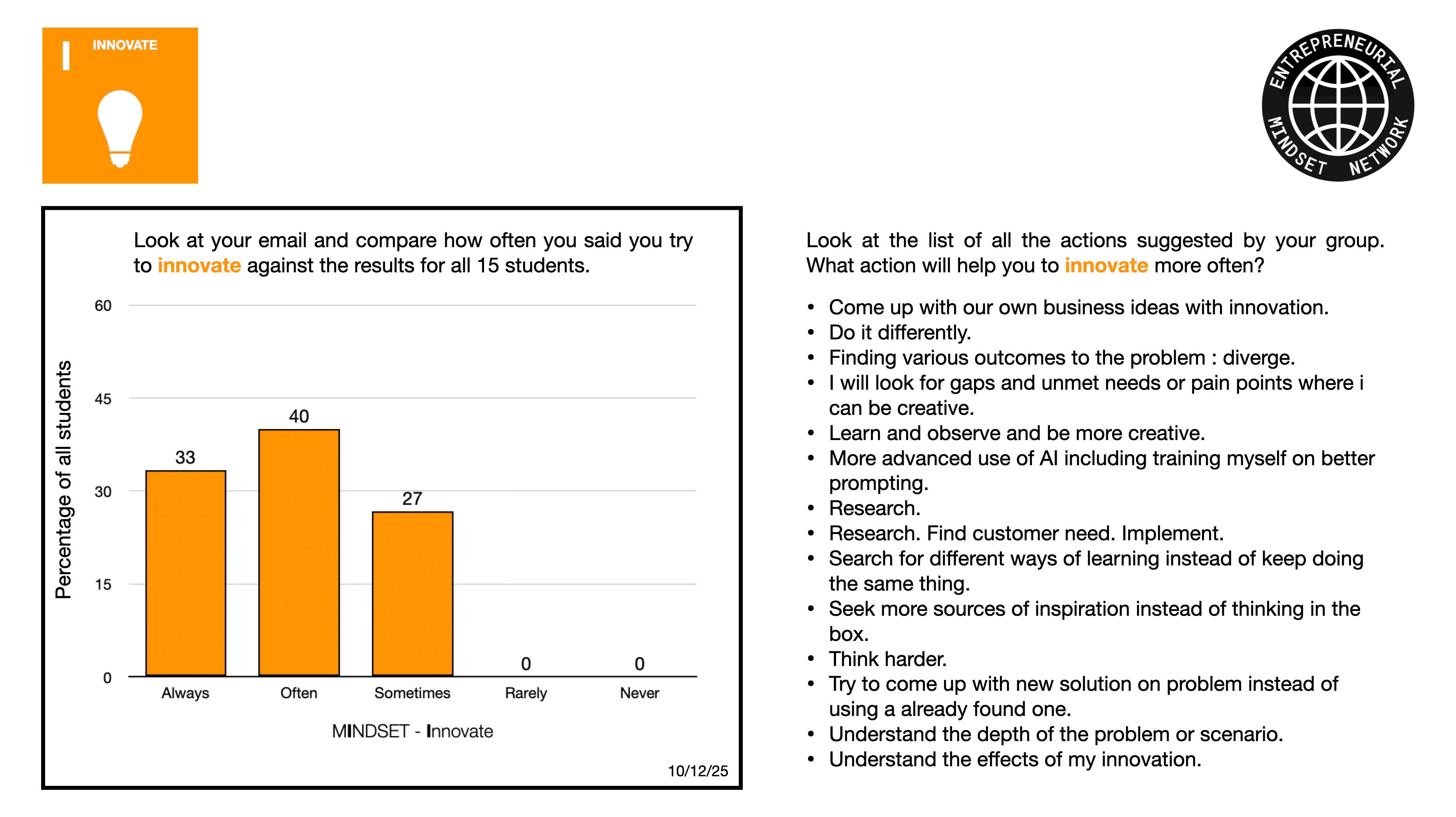
An educator can present the slide deck to the student group and facilitate discussions and exercises to deepen student learning. An educator can help each student to calibrate their self assessment by benchmarking their own results against those of the whole group. Educators can help students to evaluate the strengths and weaknesses of the actions that were crowd-sourced from the group. Educators can help students to prioritise the actions which will lead to more frequent entrepreneurial behaviours in the future.
How an educator can gain evidence of changes in student entrepreneurial behaviours
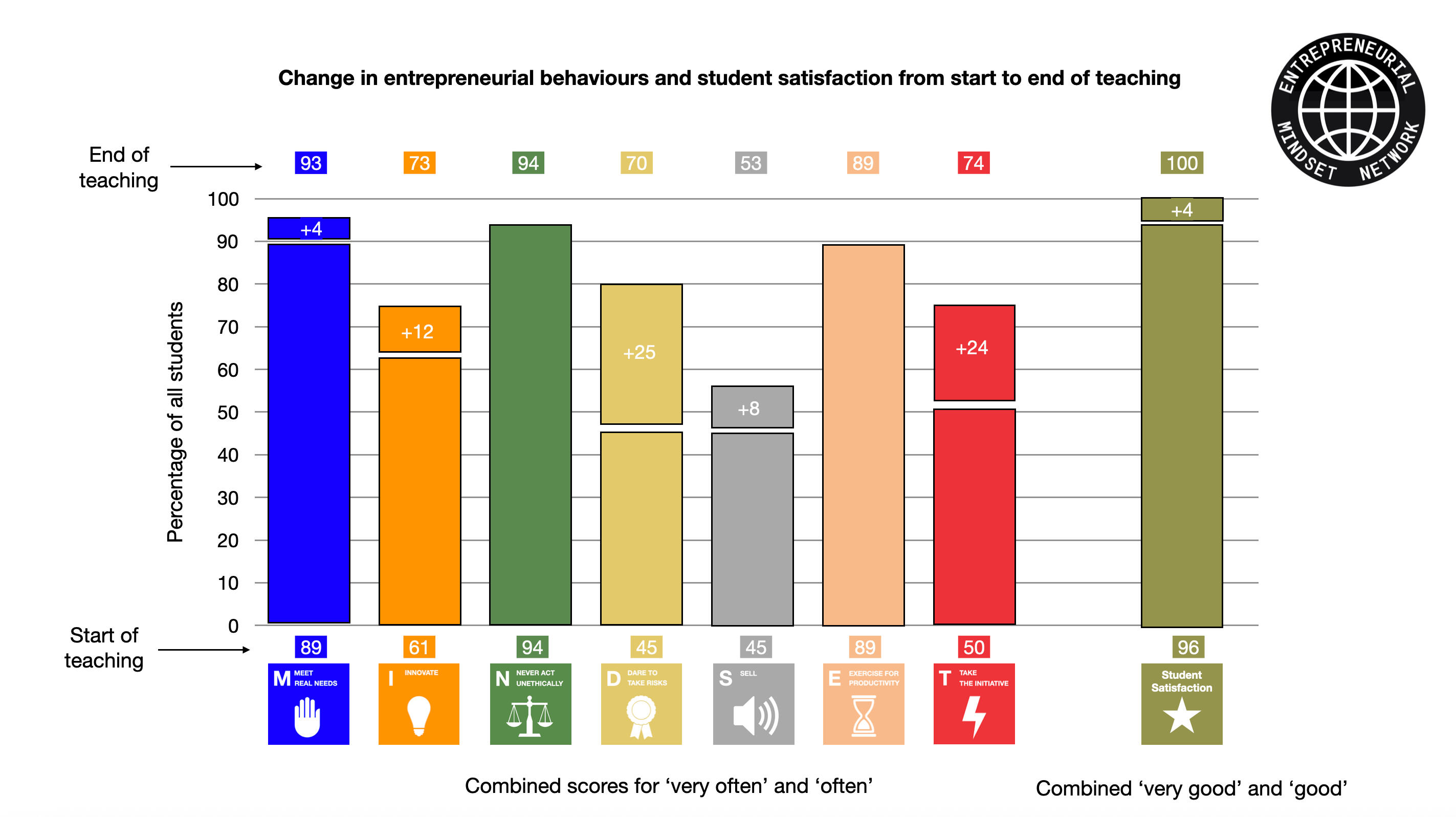
Another innovation is the ability to compare the entrepreneurial behaviours of students at two points in time e.g. at the start and again at the end of a project or module.Educators can use this report as evidence of the changes in the behaviours of their students and the impact of teaching on student progression and achievement.Educators can use the report to evaluate changes in curricula content and teaching methodologies, and to support quality assurance and marketing.
Research
Anonymised data from the tool is being used by the SHINE project (Scaling higher education innovation using the entrepreneurial mindset) to create research outputs. In the short term, research outputs will include data about students entrepreneurial behaviours and recommendations about curriculum content and the quality of teaching. In the longer term, outputs will offer comparisons of the entrepreneurial behaviours of students from different subject disciplines and analyse differences between countries.
Publications
The following books are available to purchase. 'Entrepreneurial Mindset' published by Blurb is a step-by-step guide to using the entrepreneurial mindset for students of any academic discipline. Educators will find inspiration in the book 'Entrepreneurship Education' published by Routledge which contains the chapter Scaling Higher Education Innovation Using the Entrepreneurial Mindset. The book 'Innovation and Entrepreneurship' published by Routledge contains the chapter How a digital Mindset Behaviour Analysis tool can help healthcare students to develop an entrepreneurial mindset.Click on any image to view further details of each book and the options to purchase.
Books
Briefings
The following briefings provide inspiration to educators who want to use the MBA tool with students. Click on any image to view the resource onscreen, and access the options to download and print.
List of references and authors
Copyright notice. You may quote, paraphrase or refer to information in these books and briefings on condition that you credit the author and publisher by using the following references.Bradley, L. and Cunningham, I. (2025). Entrepreneurial mindsets: lessons from the island of Ireland. Entrepreneurial Mindset Network: Express 8(1). https://express-volume-8.entrepreneurial-mindset.network
Laura Bradley (Ulster University, Northern Ireland) and Isobel Cunningham (Atlantic Technological University, Ireland) PDF linkCoyle, P. (2022). Entrepreneurial mindset: how seven essential entrepreneurial behaviours can help you to make you unique
contribution to the world. Blurb.Coyle, P. (2024). Scaling Higher Education Innovation Using the Entrepreneurial Mindset: An Interim Report of the International SHINE Project Involving Entrepreneurship Educators from 25 Countries. In R.J. Crammond and D. Hyams-Ssekasi (Eds.), Entrepreneurship Education and Internationalisation: Cases, Collaborations and Contexts (pp. 112-122). Routledge.Coyle, P. (2025). How a digital mindset behavior analysis tool can help healthcare students develop an entrepreneurial mindset. In J. Wilkesmann (Ed.), Innovation and Entrepreneurship within Health Education: International Perspectives on Multidisciplinary Collaboration and Digital Skills (pp. 230-245). Routledge.Coyle, P., Cunningham, I., Hazizi, T. & Lamas, M. (2025, September 25-26). Online Entrepreneurial Mindset Behaviour Analysis Tool. [Conference presentation]. 20th European Conference on Innovation and Entrepreneurship, Krakow, Poland.
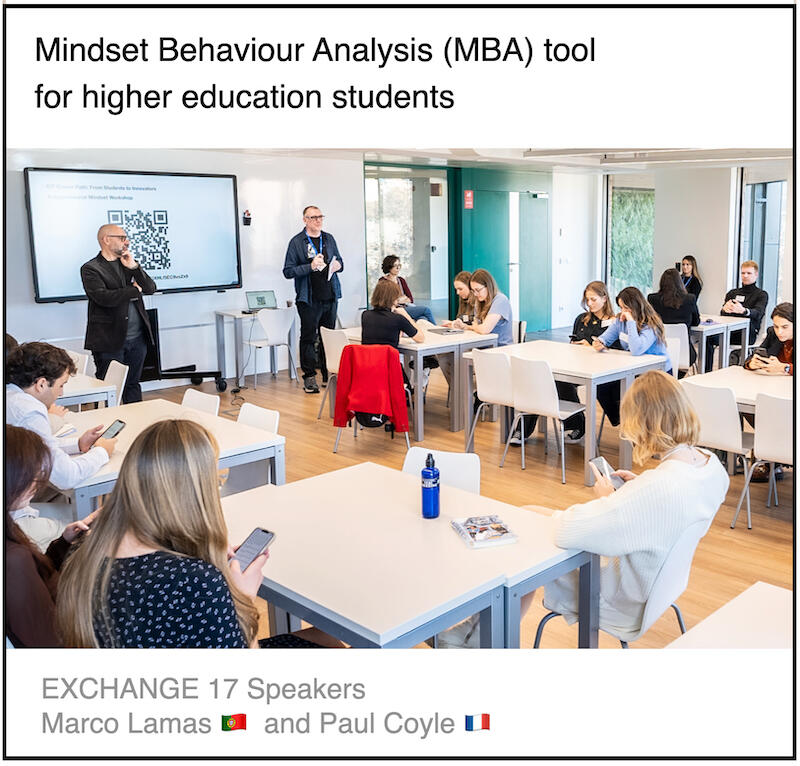
Paul Coyle (Entrepreneurial Mindset Network, France), Isobel Cunningham (Atlantic Technological University, Ireland), Teuta Hazizi (University of Elbasan "Aleksandër Xhuvani",Albania) and Marco Lamas (ISLA Gaia, Portugal). PDF LinkCoyle, P., and Lamas, M. (2024). Mindset Behaviour Analysis (MBA) tool for higher education students. Entrepreneurial Mindset Network. https://shine-project.entrepreneurial-mindset.network
Paul Coyle (Entrepreneurial Mindset Network, France) and Marco Lamas (ISLA Gaia, Portugal). PDF link
This website is published by the Entrepreneurial Mindset Network © 2026 all rights reserved.
All the content on this website is written by humans.